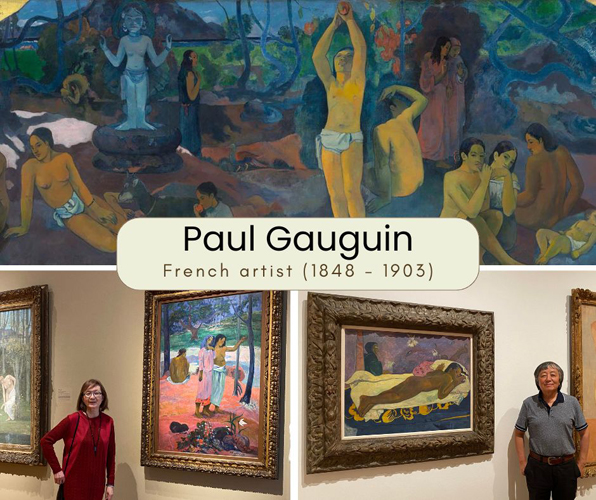
Paul Gauguin (June 7, 1848 – May 8, 1903) holds an important place in art history for his bold style, inventive use of color, and his influence on modern art. As artists, when we look at Gauguin’s work, we see someone who was willing to break away from what was accepted and search for something more personal, emotional, and symbolic.
Instead of following the Impressionists’ focus on light and the visible world, Gauguin chose to explore ideas, stories, and inner thought. His paintings from Tahiti, like “Where Do We Come From? What Are We? Where Are We Going?,” use strong color, flattened shapes, and simplified forms to express ideas about life and human experience. These works feel direct, imaginative, and thoughtful, even though they don’t follow the rules of realism.
Gauguin’s way of using color also changed how many artists thought about painting. He didn’t just use color to describe what he saw—he used it to express what he felt or wanted to say. This freedom helped lead to movements like Symbolism, Fauvism, and even parts of Expressionism. His style encouraged other artists, including Matisse and Picasso, to think differently about form and meaning.
Gauguin’s importance lies in how he opened new directions for painting and personal expression. He reminds us that art doesn’t always need to reflect the outside world—it can also reflect the inside. As artists, this idea gives us room to explore, question, and keep searching for our own voice.
Paintings and gallery views include the following paintings by Paul Gauguin:
Where Do We Come From? What Are We? Where Are We Going? (1897–98), oil on canvas. Museum of Fine Arts Boston.
The Call (1902), oil on fabric. Cleveland Museum of Art.
Spirit of the Dead Watching (1892), oil on jute mounted on canvas. Buffalo AKG Art Museum.
Read Featured Art Articles - Part One
Read Featured Art Articles - Part Two
Subscribe to our monthly e-Newsletter and stay updated with exhibitions and events!
604 Main Street, Zanesville, OH 43701